
Cookies are used on most school websites to help improve performance, understand how visitors use the site, and support certain website features. As part of this, the Amais platform uses cookies to provide schools with insights into website activity and engagement.
Privacy regulations such as UK GDPR, the Personal Information Protection and Electronic Documents Act (PIPEDA) and California Consumer Privacy Act (CCPA) require websites to inform visitors about the cookies they use and, in some cases, give visitors control over how those cookies are applied.
To support this, we provide two cookie banner options for schools:
-
a free cookie notice powered by Elfsight, and
-
a full consent management solution using CookieYes.
This guide explains how each option works, what our Amais cookie does, and how schools can choose the approach that best suits their preferences for analytics and visitor consent.
| What are the differences between the two cookie options? |
|---|
|
The two cookie banner options differ primarily in the level of cookie management and compliance features they provide. Free option
Paid option
|
| What is Ubiq's Amais cookie all about? |
|
Our Amais cookie is a first-party cookie used by the Amais platform to help schools understand how visitors use their site. It allows us to gather insights such as:
This data helps your school improve their website content and user experience. However, schools can choose to make the Amais analytics cookie optional, which allows visitors to decide whether they want analytics tracking enabled. This option is available when using the CookieYes option.
|
| Does declining analytics cookies affect how the website works? |
|
No. Declining analytics cookies does not affect the functionality of the website. Visitors will still be able to access pages, complete forms, and use all website features normally. Analytics cookies are used only to help schools understand how their site is being used and identify opportunities for improvement.
|
| Does a cookie banner affect DXP analytics the same as it does GA4? |
|
Not necessarily. The impact on analytics within the Amais platform may differ from Google Analytics (GA4) depending on how data is collection is set up. In many cases:
Because different analytics systems measure traffic in different ways, it is normal to see some variation between the DXP analytics and GA4 reports. |
| What is Google Advertising Transparency & Consent? |
|
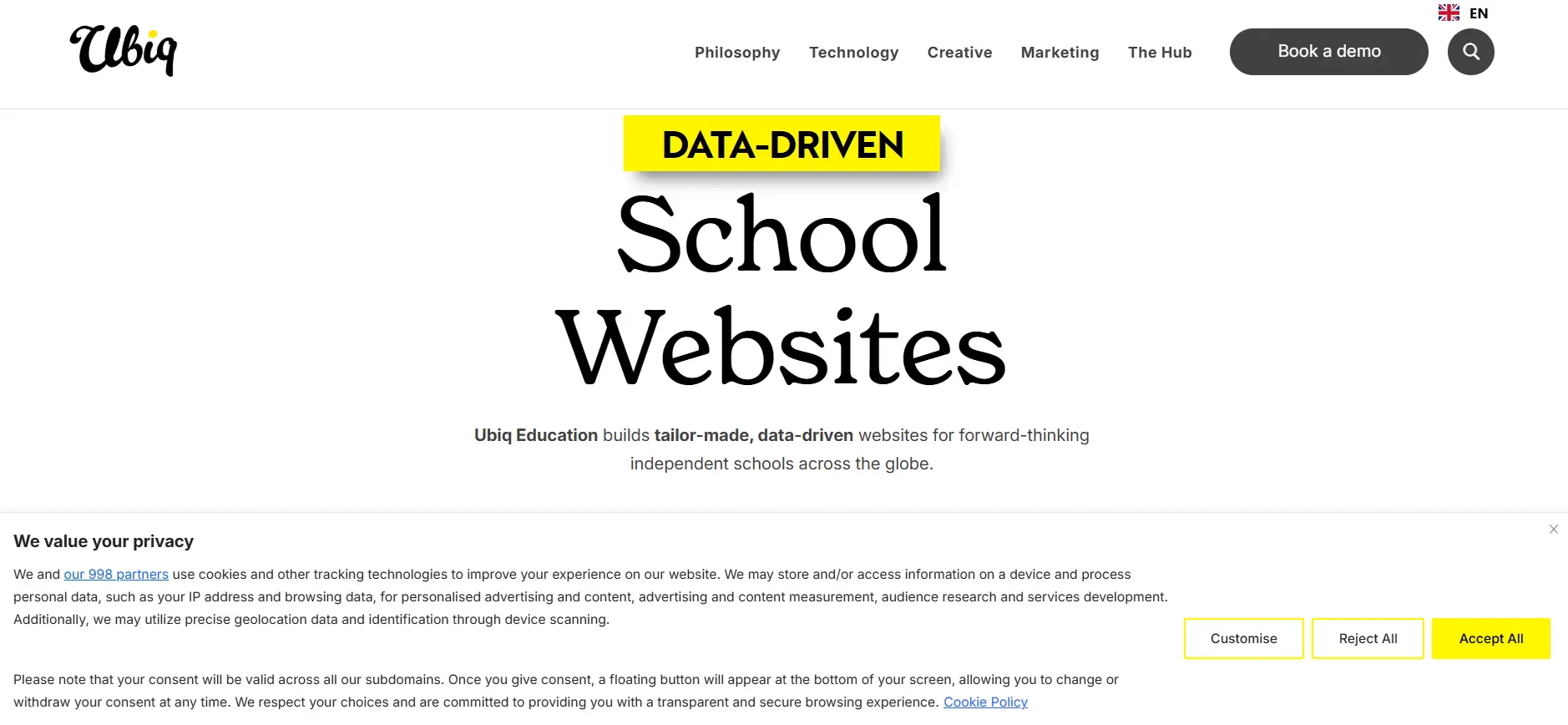
If you’re running Google Ads and using CookieYes, it is recommended to enable the IAB TCF (Transparency & Consent Framework) vendor list. When this is enabled, you will see a larger number of “partners” referenced in the banner. This figure is tied to the consent framework itself, which includes a standardised list of advertising and analytics vendors for GDPR transparency. It doesn’t mean your website is actively sharing data with all of those partners; rather, it reflects the broader framework available should a user provide consent. It’s also worth noting that the content within the banner, including the number of vendors listed, is not editable. Whilst we follow CookieYes best practices and recommendations, you do have the option to disable IAB TCF. However, if this is done, we cannot confirm that the banner would remain fully GDPR compliant, if you are using advertising features such as Google Ads.
|
| Which option should our school choose? |
|
Both options are used by schools, depending on their preferences.
For more information, please reach out to your Project Manager or Experience Director, who will be happy to help. |
Discover more


ONGOING SUPPORT
Need help with anything else?
If you can’t find the answer you’re looking for in our Knowledge Base, there are three ways you can get support: