
Date Published: 5th October 2026
For the last few years, one of the most visible applications of AI has been the trusty chatbot.
Ask a question. Get an answer.
For schools, that has opened up some genuinely useful possibilities, particularly when it comes to helping prospective families find information quickly, answering common questions outside office hours and making complex websites easier to navigate.
But while chatbots have been getting better at answering questions, AI itself has been moving in a much bigger direction. The conversation is shifting from what AI can tell us to what AI can actually do for us.
That shift is already happening in the workplace. According to McKinsey's 2025 State of AI research, 71% of organizations surveyed were regularly using generative AI in at least one business function, with marketing and sales among the most common areas of adoption.
Microsoft’s recent research points to the next stage: more than 80% of leaders expect AI agents to be moderately or extensively integrated into their AI strategy within the next 12–18 months.
The age of AI-generated answers isn't nigh. But a new era is beginning alongside it: AI that can understand context, call on specialist skills and take action. Welcome to the age of the AI Co-Creator.
In this blog:
Chatbots were just the beginning. AI is moving beyond answering questions and generating content towards systems that can understand context, take action and work alongside us.
In this blog, we explore the shift from chatbots to AI Co-Creators, unpack the differences between assistants, agents and agentic AI, and look at why context and specialist skills are becoming such an important part of the AI experience.
We’ll also explore what this evolution could mean for school marketing and admissions teams, before introducing MAISY and the new possibilities of AI Co-Creation within Ubiq AMAIS™.
- What is an AI chatbot?
- What is an AI Co-Creator?
- Why isn't generative AI alone enough
- Why context matters more than another clever prompt
- AI agents join the conversation
- What could AI Co-Creation mean for schools?
- Meet ✦ MAISY

What is an AI chatbot?
A chatbot is fundamentally designed around conversation. Someone asks a question and the technology responds, whether that's through a predetermined conversational flow or, increasingly, using generative AI to understand the request and formulate an answer.
For schools, the use case is easy to see. A prospective parent might want to know when the next Open Day is, what the application deadline looks like or whether a particular sport is available. Instead of searching through the website or waiting for the admissions office to open, they can ask.
Modern chatbots can make that experience considerably more sophisticated. They can interpret natural language, draw from much larger bodies of information and maintain more fluid conversations than the scripted bots many of us first encountered.
But their primary role is still usually the same: someone asks, the chatbot answers.
That makes them useful for helping people access information. It doesn't necessarily make them a participant in the work happening behind the website.

What is an AI Co-Creator?
An AI Co-Creator takes that relationship a step further. Instead of AI existing primarily as somewhere you go for an answer, it works alongside you to help complete a task.
The difference is action. Ask a chatbot how you could improve a webpage and it might suggest some changes. Ask a Co-Creator and it could help make those changes.
Ask an AI assistant to draft copy for an admissions landing page and it might give you 800 words to paste into your CMS. A Co-Creator operating within that CMS could potentially work with the existing page, content, imagery and brand context to help build the experience itself.
That moves AI from prompt and response towards brief and action.
It’s an important distinction because generating something has never been the whole job.
Ready to move past the chatbot?
School marketing and admissions teams are being asked to do more across more channels, often without more time or resource. Join us on October 20 to see how AI Co-Creation can change that equation. Discover what happens when AI starts working alongside your team.
Register for the official AI ✦ Co-Creation launch →
| What is an AI chatbot? | What is an AI Co-Creator? |
|---|---|
|
|

Why isn't generative AI alone enough?
Generative AI has already made the first stage of many marketing tasks dramatically faster. Copy, concepts, summaries, research and first drafts that once took hours can now appear in seconds.
And marketers are already seeing the potential.
In recent Salesforce research, marketers surveyed estimated that generative AI could save them more than five hours a week, while 71% said they expected it to eliminate busy work and give them more time for strategic work.
But there's a catch.
Imagine asking a standalone AI tool to create a new admissions page. Within seconds, you could have the copy. Somebody still needs to review it against the rest of your website, adjust the tone, find suitable imagery, resize those images, open the CMS, create the page, build the layout, add the content, write the metadata, optimize it for search, preview everything and publish it.
AI might have made one part of the task incredibly fast without removing the workflow around it.
For busy marketing and admissions teams, that's an important difference. Saving ten minutes writing copy is useful. Removing several steps from the entire process is potentially transformative.

What makes a Co-Creator different from an AI assistant?
AI terminology is evolving quickly, and the lines between chatbots, assistants, agents and Co-Creators can sometimes feel blurred. Each represents a different way of interacting and working with AI, from simply getting an answer to collaborating on an outcome.
Here's a breakdown:
- AI Chatbot - Answers: Primarily designed for conversation, responding to questions and helping users find information.
- AI Assistant - Supports: Helps you think, create and analyze, generating content, ideas or recommendations that you can take forward.
- AI Agent - Acts: Uses available tools and information to carry out specific tasks or work towards a defined goal within set parameters.
- AI Co-Creator - Collaborates: Brings context, creation and action together, working alongside you to move from an idea towards a finished outcome.
That final distinction matters. When it comes down to it, Co-Creation isn't about removing the human from the process; it's about challenging where human time is best spent. Your team still brings the ideas, judgment, creativity and understanding of your school. AI just brings additional capacity and specialist capabilities around them. At the end of the day, you know your school better than anybody else.
Need more hands, not more tools?
See how AI Co-Creation can give school marketing and admissions teams more capacity to create, optimize and get more done, without adding another platform to the pile.
Explore Co-Creation in action →

Why context matters more than another clever prompt.
Anyone who regularly uses a general-purpose AI tool will recognize the ritual. First, you explain your organization. Then your audience. Then your objective. Then your tone of voice. Then you paste in the existing content. Then you clarify the brief when the first answer isn't quite right.
Often, the problem isn't the intelligence of the AI. It's the absence of context.
Standalone AI tools naturally sit outside the systems where your team works. They don't automatically know which webpage you're editing, what content already exists elsewhere on your website, which terminology your school uses or which assets are sitting in your image library.
You have to bring the context to the AI before the AI can bring much value to you. Borrrinnggggg.
Embedding AI into the environment where the work actually happens changes that equation. If it can understand the page you're working on, the content surrounding it, your existing assets and the conventions of your school, there is far less need to repeatedly explain the task from scratch.
The better the context, the less time you spend prompting and the more time AI can spend helping.

AI agents have joined the conversation.
There's another shift happening at the same time. Until now, most of us have experienced AI as one general-purpose assistant that we ask to do almost everything. But that's not how we build human teams.
You probably wouldn't expect the same colleague to be your copywriter, SEO specialist, researcher, designer, image editor, social media manager and receptionist. Each discipline requires different skills and knowledge.
AI agents introduce a similar idea digitally. Specialist agents can focus on particular tasks or disciplines, using the tools and context relevant to that work.
And global businesses and enterprises are already looking in this direction. In Microsoft's 2025 Work Trend Index, they found that 36% of leaders surveyed expected managing agents to become part of their jobs within five years. Parents are expecting this level of
That shift matters for schools, too. The families you're trying to reach don't experience your school in isolation. Every day, they're interacting with businesses and services investing in faster, smarter and increasingly personalized digital experiences. As those experiences evolve, the benchmark for what feels intuitive, responsive and useful evolves with them.
If that's the experience parents are becoming accustomed to everywhere else, why should interacting with their school feel a generation behind?
A Co-Creator can provide the layer above those specialists. Instead of expecting the person using it to understand which model, tool or agent should tackle a job, they can simply start with the outcome they want.
The good news? You don't need to know which AI you need. You just need to know what you're trying to achieve. Easier said than done, we know.
Is your school ready for what comes next?

What could AI Co-Creation mean for schools?
This shift is particularly relevant for school marketing and admissions teams because the challenge is rarely a shortage of ideas. It's capacity.
There are more channels to manage, more content to create, more data to understand, greater expectations around personalization and growing pressure to demonstrate what's actually influencing enrollment.
And underneath that strategic work sits a constant stream of smaller tasks. Pages need updating. Images need resizing. Campaigns need launching. Reports need pulling. Events need promoting. Social posts need creating. Content needs repurposing. Search performance needs monitoring.
The opportunity for AI isn't to help people write those things slightly faster. It's to give teams additional capacity by helping take more work from idea to done.
That requires AI to understand the environment it's operating in, access the right specialist capabilities and, crucially, be able to take action. Enter MAISY.
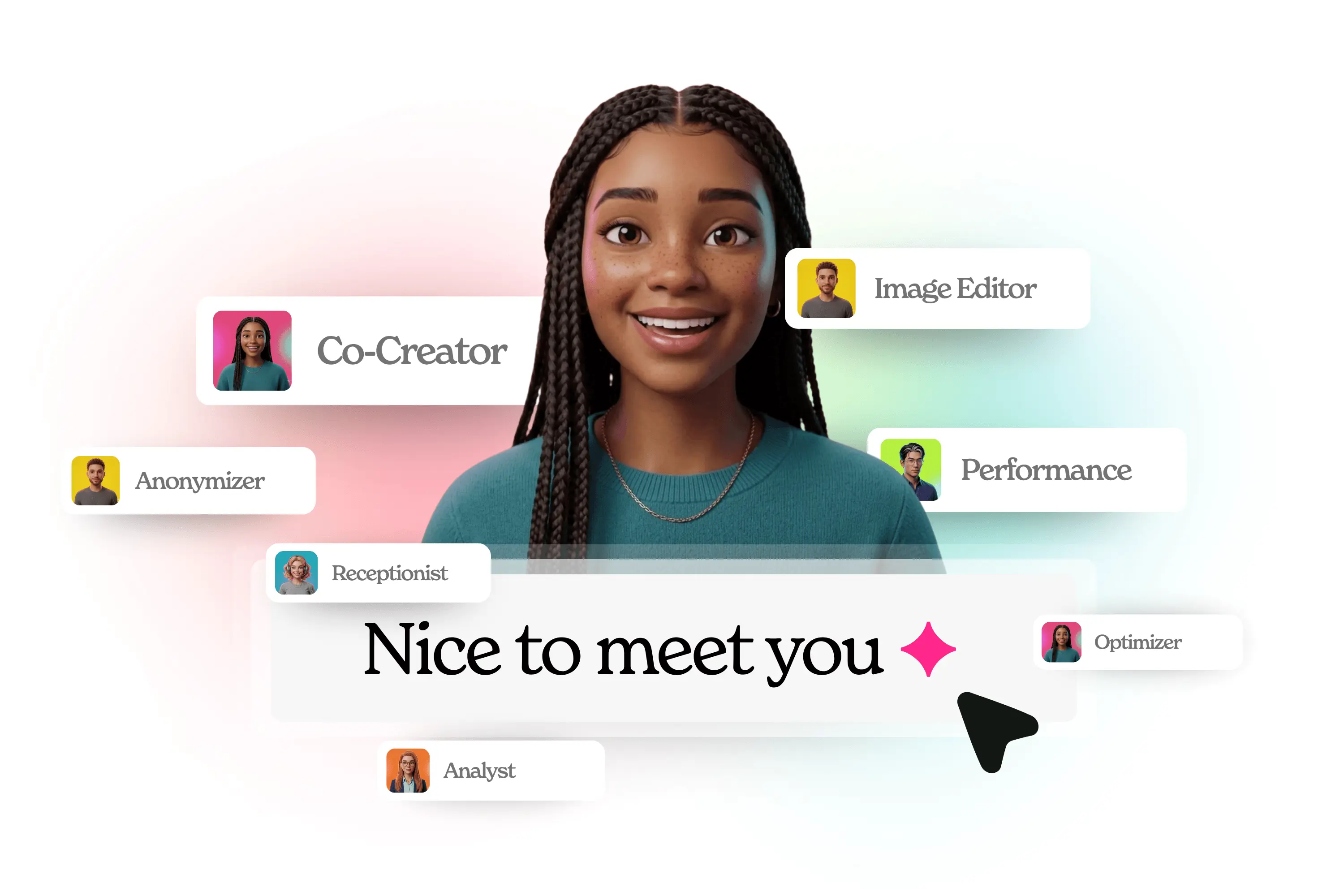
Meet ✦ MAISY, Ubiq's native AI Co-Creator.
So, where does all of this leave us?
Chatbots gave us a new way to find answers. AI assistants helped us create, research and analyze faster. Agents are taking things further again, bringing specialist skills and the ability to take action.
Naturally, the next step is bringing those capabilities together.
That's the thinking behind MAISY, Ubiq's native AI Co-Creator, built directly into Ubiq AMAIS™. Rather than being another standalone AI tool your team needs to learn, manage and constantly feed with context, MAISY lives within your website where the hardwork is already happening.
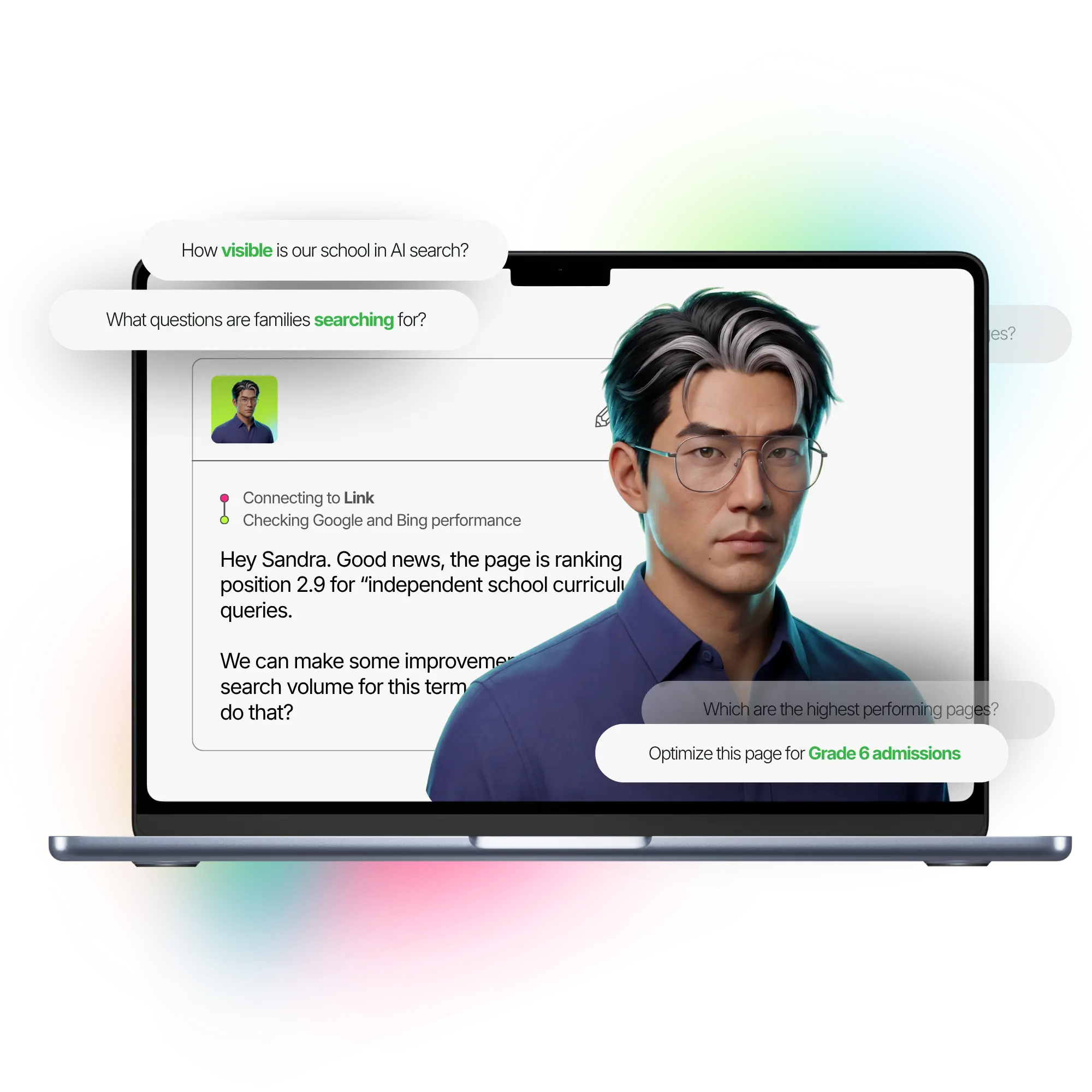
She's page-aware, so she understands what you're working on without you having to copy, paste and explain it. She's school-aware, working with your existing content, terminology and brand guidelines. And she's action-oriented, helping you move beyond generating an answer to actually creating, updating and managing work within the platform.
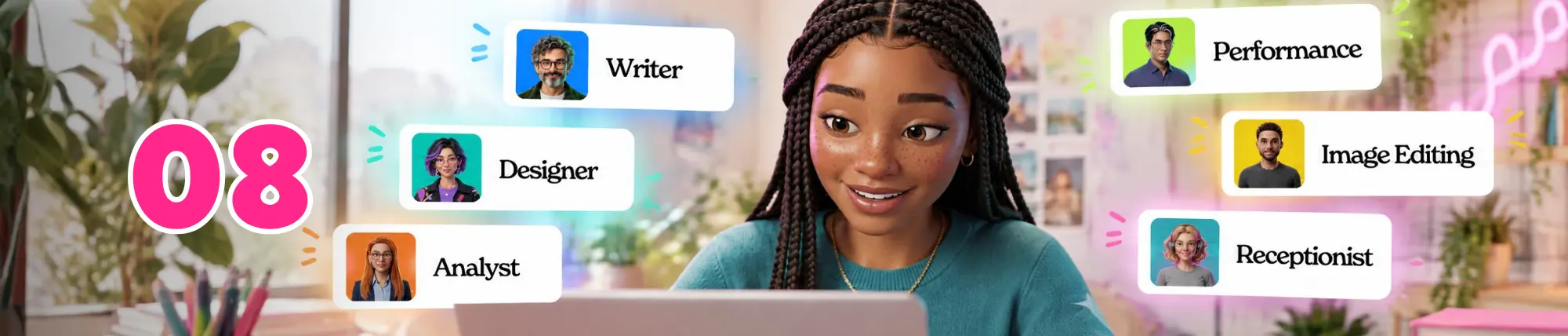
But being a Co-Creator doesn't mean trying to be an expert in everything. Just like your own team, MAISY has specialists she can call on. Behind her is a growing team of AI agents, each focused on a different discipline: Kit for content, Scout for social, Link for SEO and AI search, Tracey for research, Drew for design and Cam for image editing, with Paige joining the team to support prospective family enquiries.
And that team will continue to grow.
So instead of asking an AI assistant:
“Can you write some copy for an admissions page?”
You can start with the outcome:
“Create a new admissions page using our existing content and match the style of the rest of our website.”
From there, the right context, capabilities and specialist skills can come together to complete the task at hand.
That's the real shift from chatbot to Co-Creator. Less time figuring out how to use AI. More time putting it to work. Start with ✦ MAISY. She'll take it from there.
One Co-Creator.
|
Frequently Asked
Questions
| What is the difference between an AI chatbot and an AI Co-Creator? |
|---|
| An AI chatbot is primarily designed to answer questions and provide information through conversation. An AI Co-Creator goes further, combining context, creation and action to work alongside a person and help move a task from idea to outcome. |
| How could AI Co-Creators help school marketing and admissions teams? |
| AI Co-Creators can give school teams additional capacity across everyday marketing and admissions work. That could include creating and updating website content, repurposing campaigns, researching markets, improving search visibility, preparing imagery and supporting prospective family communications. The aim is to reduce time spent on repetitive execution so teams have more time for strategy, creativity and relationships. |
| Will AI Co-Creators replace marketing and admissions teams? |
| Co-Creators are designed to work with people, not remove them from the process. AI can bring additional speed, capacity and specialist skills, but people still provide the judgment, creativity, strategy and understanding of their school and community that shape the work. The opportunity is less about replacing the team and more about expanding what that team can do. |
| Can schools create their own AI agents? |
|
Yes. Alongside MAISY’s growing team of specialist agents, schools using Ubiq AMAIS™ can create their own agents around the needs of their school. That means you can build specialist AI capabilities for your own workflows, knowledge and priorities, extending your AI team beyond the agents already available. As your needs evolve, your AI team can evolve with you. |
 |
Meet The Author: Molly Johnston, Content Marketing Manager With over a decade of experience in marketing, Molly specialises in turning complex ideas into clear, engaging content that helps brands communicate with clarity and impact. She creates content that resonates with real audiences, helping schools connect more meaningfully with families at every stage of their journey. Outside of work, she’s usually cooking something overly ambitious or being managed by four cats; a setup that keeps things entertaining, and her clothes permanently covered in fur. |